From Curiosity to Capability: The AI-Native Workforce
Why Learning Faster Matters More Than Working Harder
“The most valuable professional of the next decade won’t be the one who knows the most—it will be the one who learns the fastest.”
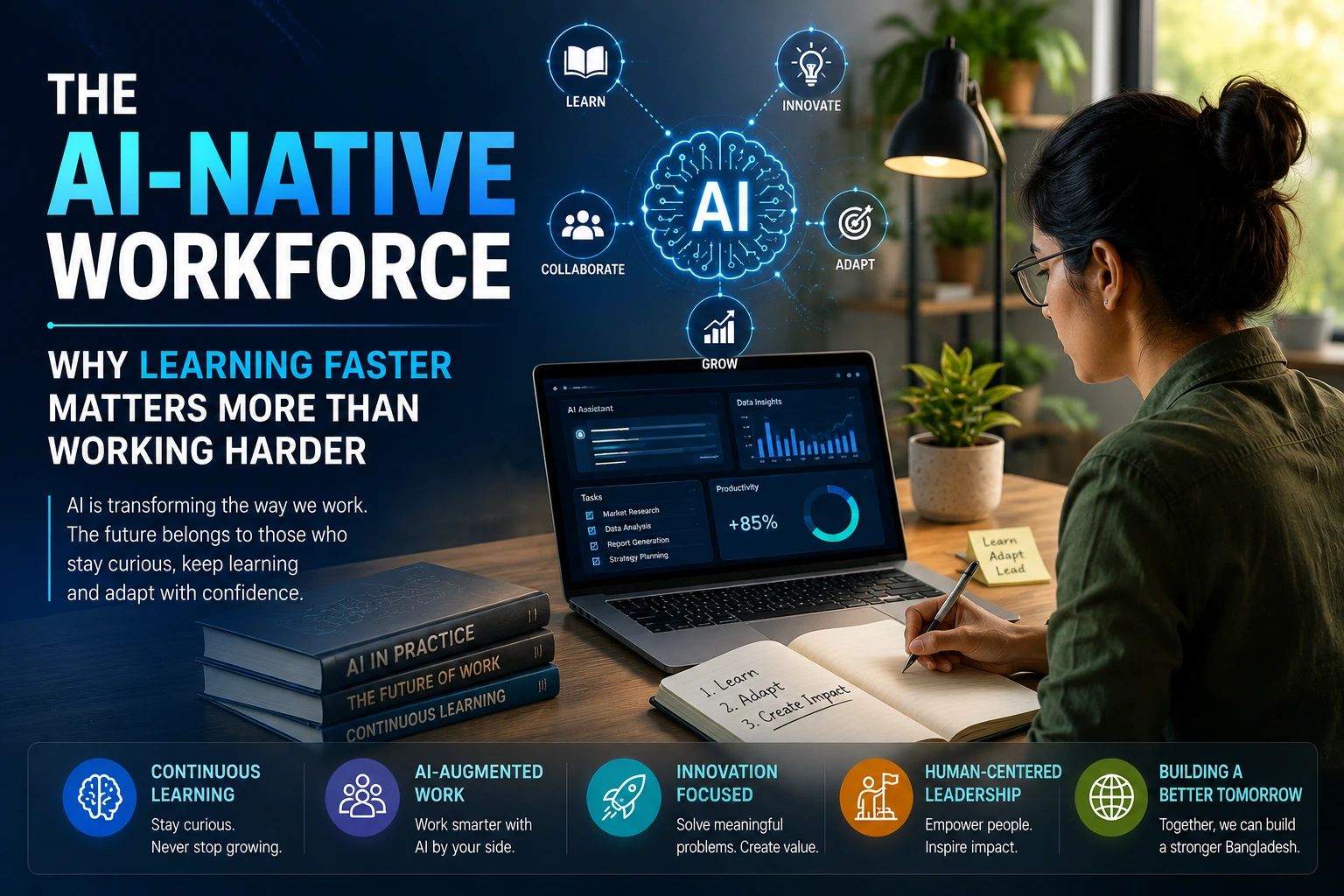
Artificial Intelligence is changing the rules of work faster than any technological revolution in recent history. Just a few years ago, learning a new programming language, mastering cloud platforms, or understanding data analytics could set a professional apart. Today, those skills are quickly becoming baseline expectations.
The real differentiator is no longer what we know. It is how quickly we can learn, adapt, and apply new knowledge.
This marks the beginning of what I call the AI-native workforce—a generation of professionals who don’t simply use AI tools; they naturally collaborate with them to solve problems, make decisions, and create value.
From Digital Literacy to AI Literacy
Twenty years ago, digital literacy meant knowing how to use a computer, email, spreadsheets, and office software. Today, AI literacy is becoming just as fundamental.
AI literacy isn’t about building neural networks or earning a PhD in machine learning. It means understanding how AI can enhance everyday work.
- A software engineer may use AI to generate boilerplate code.
- A business analyst may summarize thousands of customer records in minutes.
- A project manager may generate project plans and risk assessments in seconds.
- A marketing executive may create personalized campaigns for multiple customer segments.
The professionals who thrive will not be those competing against AI but those who know how to ask better questions, validate AI-generated outputs, and combine technology with human judgment.
A New Definition of Productivity
For decades, productivity was measured by effort.
- How many hours did someone work?
- How many reports were produced?
- How many lines of code were written?
AI changes this equation entirely.
Today, productivity is increasingly measured by outcomes.
- One engineer equipped with modern AI development tools can accomplish work that previously required an entire team.
- Designers can iterate through concepts in hours instead of weeks.
- Customer support agents can resolve issues faster because AI handles repetitive inquiries while humans focus on empathy and complex decision-making.
This doesn’t diminish human contribution—it elevates it.
The value shifts from performing repetitive tasks to solving meaningful problems.
The Rise of AI-Augmented Teams
Perhaps the most exciting transformation is happening at the team level.
Organizations are moving from traditional hierarchies toward AI-augmented collaboration.
Imagine a product development team where:
- AI generates initial design concepts.
- Engineers use AI-assisted coding tools to accelerate development.
- Test automation identifies defects before deployment.
- Data analytics predict customer behavior.
- Human leaders make strategic decisions based on these insights.
This is no longer science fiction.
It is becoming standard practice across leading technology companies.
The organizations that adopt this collaborative model will innovate faster, respond more quickly to market changes, and create better customer experiences.
Bangladesh’s Competitive Advantage
Bangladesh has always been known for resilience and adaptability.
- Our software engineers build products for global markets.
- Our freelancers compete internationally.
- Our entrepreneurs continue solving local problems with innovative technology.
These strengths become even more valuable in the AI era.
Unlike many developed economies burdened by legacy systems and aging workforces, Bangladesh has a young, ambitious, and increasingly technology-savvy population. This provides a unique opportunity to embrace AI not as a disruptive force but as a catalyst for growth.
Leadership Must Change Too
Technology alone will not determine success.
Leadership must evolve alongside it.
The best leaders in the AI era will no longer be those with all the answers. Instead, they will be the ones who ask the right questions, encourage experimentation, and build cultures where continuous learning becomes part of everyday work.
- Organizations that punish mistakes often discourage innovation.
- Organizations that celebrate learning create innovators.
Building AI-First Organizations
Across Bangladesh, forward-looking companies are beginning to rethink how software is built and how teams operate.
At Fronture Technologies Limited, AI is increasingly embedded into engineering workflows—not as a replacement for developers, but as a force multiplier. Engineers leverage AI-assisted development, automation, cloud-native architectures, and intelligent analytics to deliver higher-quality software more efficiently. The emphasis extends beyond productivity; it focuses on cultivating a culture of continuous learning, experimentation, and knowledge sharing.
This reflects a broader movement within Bangladesh’s technology ecosystem. Companies are realizing that sustainable competitive advantage will come not from the lowest development cost, but from the highest capacity to innovate.
The Human Skills That Matter Most
Ironically, as AI becomes more powerful, uniquely human skills become more valuable.
- Critical thinking.
- Ethical decision-making.
- Communication.
- Leadership.
- Creativity.
- Empathy.
These qualities cannot be automated easily.
The future workforce will combine technological capability with emotional intelligence. Professionals who master both dimensions will lead teams, build businesses, and solve problems that machines alone cannot.
Looking Ahead
The AI revolution is not a destination—it is an ongoing journey.
- Every month, new tools emerge.
- Every year, new skills become essential.
- Every industry continues to evolve.
The professionals who embrace lifelong learning will discover opportunities that were unimaginable only a few years ago.
Bangladesh has all the ingredients needed to become one of the world’s leading technology talent hubs: a young workforce, entrepreneurial energy, growing digital infrastructure, and a rapidly expanding software industry.
Our greatest challenge is no longer access to technology.
It is our willingness to evolve with it.
The future will belong to those who remain curious long after everyone else believes they know enough.
Because in the age of AI, learning is no longer preparation for work.